Lasso Regression, In Full Depth
Ridge Regression shrinks every weight toward zero but never eliminates any of them. Lasso uses a different penalty that can drive weights to exactly zero — turning regularization into automatic feature selection.
What Is Lasso Regression?
Same hypothesis as Linear Regression — — with a different penalty than Ridge added to the cost function. "Lasso" stands for Least Absolute Shrinkage and Selection Operator — the name is a description of exactly what it does.
The Lasso Cost Function
The only change from Ridge is the penalty term: — the L1 norm of the weights (sum of absolute values, see Linear Algebra — Norms) instead of the L2 norm (sum of squares).
Why L1 Produces Exact Zeros (and L2 Doesn't)
This is the single most important thing to understand about Lasso, and it comes down to the shape of the penalty, not just its magnitude.
has a constant derivative of (technically undefined exactly at — a subgradient, see below) for any nonzero , no matter how small. 's derivative is , which shrinks toward zero as shrinks toward zero — the penalty's pull weakens exactly when it would matter most for actually reaching zero.
Concretely: near , Ridge's penalty gradient vanishes, so the pull toward zero becomes negligible — weights approach zero asymptotically but essentially never land on it exactly. Lasso's penalty gradient stays constant magnitude all the way to zero, so it can push a small weight the rest of the way to exactly 0 and keep it there once the data's own pull (the MSE gradient) is weaker than that constant penalty pull.
The Subgradient at Zero
isn't differentiable at exactly — the slope jumps from to . Optimizing Lasso by plain gradient descent as written doesn't quite work at that point; two standard approaches:
- Subgradient: use any value in as a stand-in derivative at (commonly 0), and take (slower) subgradient descent steps.
- Coordinate descent (the standard approach in practice): optimize one weight at a time, holding the others fixed. For a single weight, the optimal update has a closed form — the soft-thresholding operator:
where is the OLS-optimal value for given the other weights fixed. Read directly: if 's magnitude is smaller than , gets set to exactly zero. If it's larger, shrinks by exactly toward zero, keeping its sign. This closed-form "shrink or zero it" rule, applied to one coordinate at a time until convergence, is what actual Lasso solvers (like scikit-learn's) use — not naive gradient descent.
The Regularization Path
Compare directly against Ridge's path — same synthetic data, same range of :
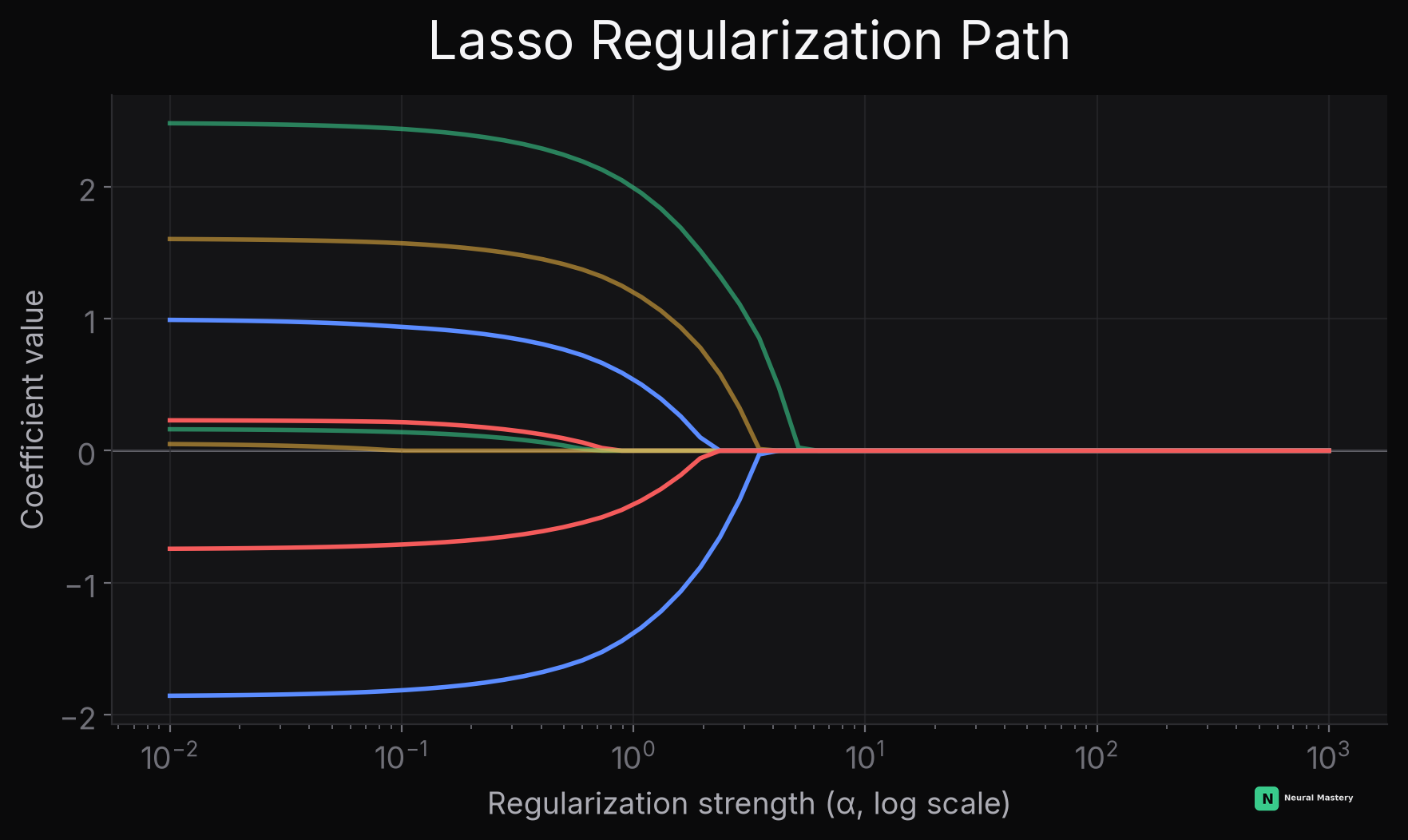
Notice the qualitative difference from Ridge's curve: coefficients here go flat at exactly zero and stay there, at different thresholds for different features — Lasso is silently doing feature selection as increases, keeping only the features whose signal is strong enough to survive the penalty.
Try the real coordinate-descent solver below — same dataset, same λ range as the Ridge Studio, so the two paths are directly comparable:
When to Use Lasso Over Ridge
- You suspect many features are irrelevant, and want the model to identify and drop them automatically
- You want a sparse, more interpretable model — fewer nonzero coefficients means a simpler story about what actually drives predictions
- Caveat: when features are highly correlated, Lasso tends to arbitrarily keep one and zero out the others, rather than spreading weight across them the way Ridge does — this can make Lasso's feature selection less stable than it looks (rerunning on a slightly different data sample can pick a different feature from the correlated group).
Minimal Implementation
Coordinate descent with soft-thresholding, matching the derivation above:
Next: Elastic Net — combining both penalties to get Ridge's stability with Lasso's feature selection.