DBSCAN & HDBSCAN, In Full Depth
K-Means assumes round, similarly-sized blobs and forces every point into a cluster. DBSCAN drops both assumptions: it finds clusters of any shape, defined purely by density, and explicitly labels sparse points as noise rather than forcing them into a nearby group.
DBSCAN (Density-Based Spatial Clustering of Applications with Noise)
Two parameters define everything: (a distance radius) and min_samples (a density threshold). Every point falls into one of three roles:
- Core point: has at least
min_samplesother points within distance of it. - Border point: within of a core point, but doesn't itself have enough neighbors to qualify as core.
- Noise point: neither — too isolated to belong to any cluster.
The algorithm: pick an unvisited point; if it's a core point, start a new cluster and recursively absorb every point density-reachable from it (every neighbor within , and their neighbors, and so on, as long as each new point is itself a core point or directly borders one). If the starting point isn't core, mark it as noise (for now — it may still get absorbed later as a border point of some other cluster). Repeat until every point has been visited.
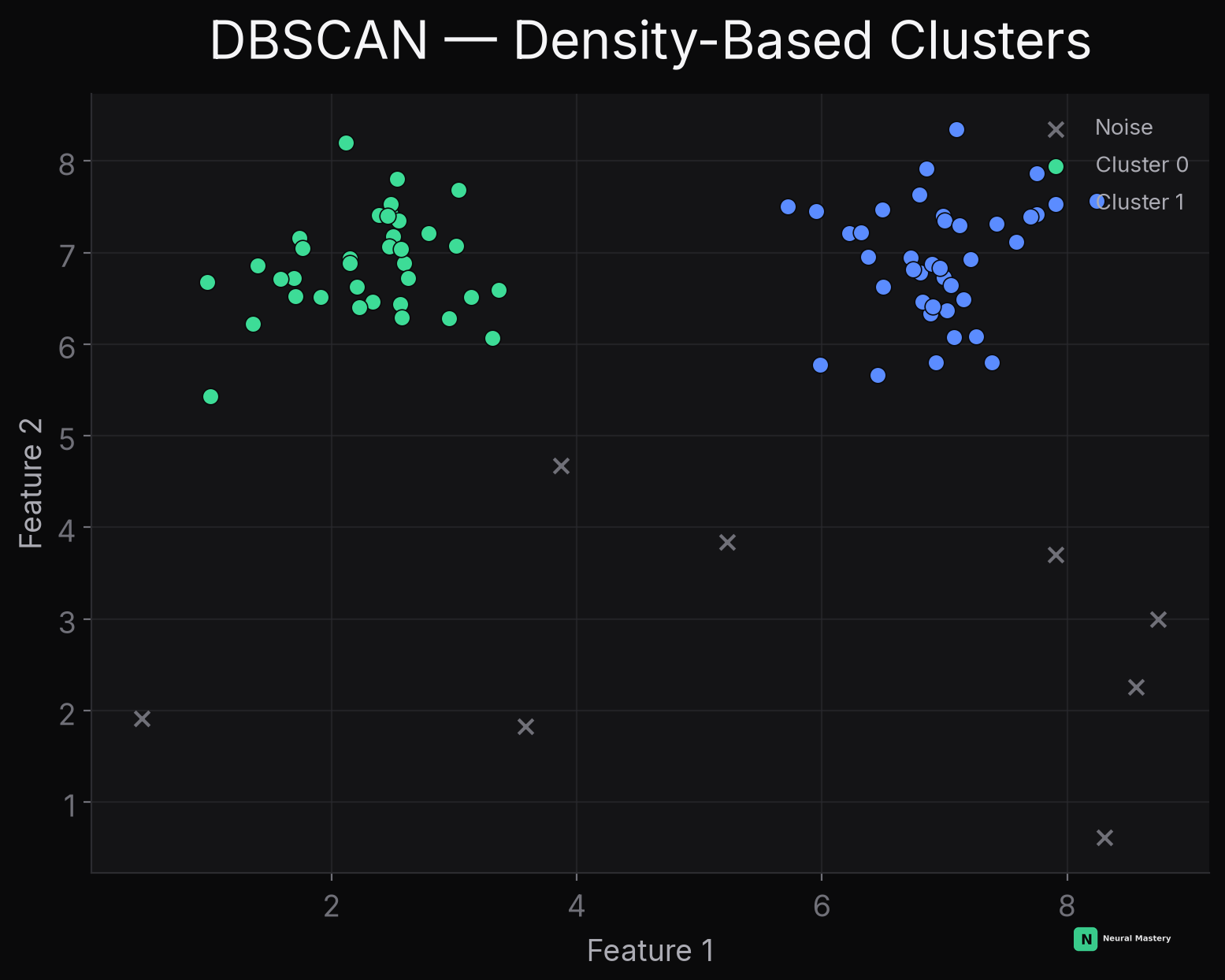
Why this handles non-convex shapes natively: nothing in the algorithm ever computes a centroid or assumes a shape — clusters grow purely by chaining together dense neighborhoods, so an elongated, curved, or ring-shaped cluster is found exactly as easily as a round one. This is precisely why DBSCAN succeeds on the two-moons data where K-Means fails.
Choosing and min_samples: min_samples is often set based on data dimensionality (a common heuristic: , where is the number of features). is typically chosen via a k-distance plot — sort each point's distance to its -th nearest neighbor, plot it, and look for the "knee" where distances start increasing sharply — the same elbow-finding intuition as K-Means' elbow method, applied to density instead of inertia.
Real DBSCAN, run live — drag ε and min_samples and watch cluster count, noise count, and every point's role recompute for real:
Weakness: a single global assumes roughly uniform density everywhere. If one region of the data is naturally denser than another, one can't serve both well — too small and it fragments the dense region; too large and it merges the sparse region into noise or into the wrong cluster.
HDBSCAN (Hierarchical DBSCAN)
Fixes DBSCAN's single- limitation directly: instead of one fixed radius, HDBSCAN builds a hierarchy across a range of values (conceptually similar to the dendrogram from hierarchical clustering, but built from density rather than raw distance), then extracts the most stable clusters across that range — clusters that persist over a wide span of values are considered genuine; clusters that only appear briefly at one specific are treated as noise or merged.
Practical result: HDBSCAN needs only min_samples (or min_cluster_size) as a real hyperparameter — no to tune at all — and handles varying-density data that plain DBSCAN cannot, at the cost of somewhat higher computational complexity and a less intuitive parameter to reason about than a simple distance radius.
When to Use Density-Based Clustering
- Cluster shapes are irregular, elongated, or nested (rings within rings) — where K-Means's spherical assumption breaks down.
- The dataset genuinely contains noise/outliers that shouldn't be forced into any cluster — geospatial data, sensor readings, anomaly-adjacent data.
- You don't know the number of clusters upfront, and don't want to guess — DBSCAN/HDBSCAN discover the cluster count automatically from the data's density structure.
- Not ideal when: clusters genuinely do vary smoothly in density with no clear gaps (DBSCAN needs some density contrast to find boundaries at all), or the dataset is very high-dimensional (density becomes a less meaningful concept — the same curse of dimensionality that hurts KNN affects any distance/density-based method).
Next: Gaussian Mixture Models & Spectral Clustering — a probabilistic take on clustering, and a graph-based approach that handles non-convex shapes through an entirely different mechanism than density.